

In the fish meal processing industry, ensuring the uniform cooling of fish meal is crucial for maintaining its quality and preventing spoilage. As a leading Fish Meal Cooler supplier, we understand the significance of this process and have developed advanced cooling solutions to meet the industry's demands. In this blog, we will explore how our fish meal coolers achieve uniform cooling, highlighting the key features and technologies involved.
The Importance of Uniform Cooling
Fish meal is produced through a series of cooking, pressing, and drying processes, which result in a high - temperature product. However, high temperatures can lead to moisture retention, bacterial growth, and degradation of nutrients in the fish meal. Uniform cooling is essential for several reasons:
- Quality Preservation: By rapidly and evenly reducing the temperature of fish meal, the degradation of proteins, vitamins, and other nutrients is minimized. This ensures that the fish meal retains its nutritional value, making it a more valuable feed ingredient.
- Safety: Cooled fish meal is less likely to support the growth of bacteria, fungi, and other microorganisms. This reduces the risk of spoilage and contamination, ensuring the safety of the final product.
- Storage and Handling: Uniformly cooled fish meal is easier to store and handle. It has a lower moisture content, which reduces the likelihood of caking and clogging during storage and transportation.
How Our Fish Meal Coolers Ensure Uniform Cooling
Our fish meal coolers are designed with several features and technologies that work together to achieve uniform cooling. Here are the key aspects:
Airflow Design
One of the fundamental principles of our fish meal cooler design is the efficient management of airflow. We use advanced computational fluid dynamics (CFD) simulations to optimize the airflow patterns within the cooler. This ensures that the cooling air is evenly distributed across the entire cross - section of the fish meal bed.
For example, in our Fish Meal Cooler with Air Cooling, the air inlet and outlet are carefully positioned to create a parallel and uniform airflow through the fish meal. The cooling air enters the cooler at a controlled velocity and temperature, and it passes through the fish meal from the bottom to the top. This counter - current flow ensures maximum heat transfer between the air and the fish meal, resulting in uniform cooling.
Adjustable Cooling Parameters
Our fish meal coolers allow for precise control of cooling parameters such as air temperature, airflow rate, and residence time. By adjusting these parameters, operators can customize the cooling process according to the specific characteristics of the fish meal, such as its initial temperature, moisture content, and particle size.
For instance, if the fish meal has a high initial temperature, the airflow rate can be increased to enhance the cooling efficiency. Similarly, if the fish meal has a larger particle size, the residence time can be extended to ensure that the heat is evenly dissipated from the core of the particles. This flexibility in parameter adjustment helps to achieve uniform cooling regardless of the variations in the fish meal properties.
Multiple Cooling Zones
Many of our fish meal coolers are equipped with multiple cooling zones. Each zone can be independently controlled in terms of airflow and temperature. This design allows for a more gradual and controlled cooling process, which is particularly beneficial for achieving uniform cooling of large volumes of fish meal.
In our Fish Meal Cooler with combined water and air cooling, the first zone may use water cooling to rapidly reduce the high initial temperature of the fish meal. Then, the subsequent zones use air cooling to fine - tune the temperature and ensure uniformity. The use of multiple cooling zones also helps to prevent thermal shock, which can cause cracking and other quality issues in the fish meal.
Heat Transfer Enhancement
To improve the efficiency of heat transfer and ensure uniform cooling, we have incorporated several heat transfer enhancement techniques in our fish meal coolers. One such technique is the use of a specialized heat transfer surface. The interior surfaces of the cooler are designed to have a large surface area in contact with the fish meal, which increases the heat transfer rate.
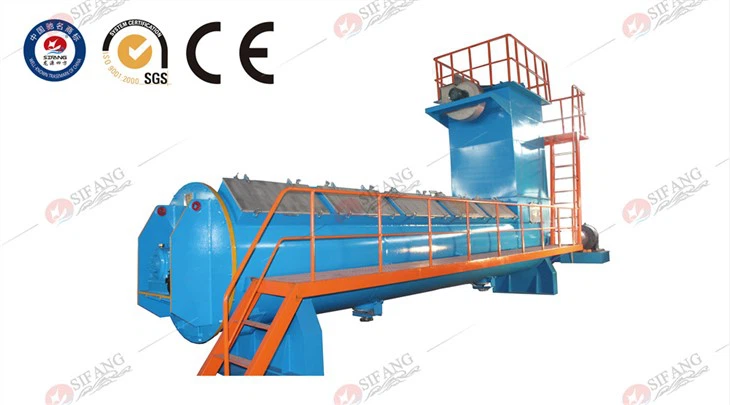

Another technique is the addition of internal mixing devices. These devices help to continuously turn and mix the fish meal as it moves through the cooler. By exposing different parts of the fish meal to the cooling air, the internal mixing devices enhance the uniformity of heat transfer and ensure that all particles are cooled evenly.
Advanced Technologies in Our Fish Meal Coolers
In addition to the above - mentioned features, our fish meal coolers are also equipped with advanced technologies that further improve the uniformity of cooling:
Sensor - Based Control Systems
Our coolers are fitted with a network of sensors that continuously monitor the temperature, humidity, and airflow within the cooler. These sensors provide real - time data to a central control system, which can automatically adjust the cooling parameters based on the monitored values.
For example, if the sensors detect a temperature variation in a particular area of the cooler, the control system can increase the airflow rate in that area or adjust the air temperature to ensure uniform cooling. This intelligent control system helps to minimize manual intervention and ensures consistent and uniform cooling performance.
Energy - Efficient Designs
We understand the importance of energy efficiency in the fish meal processing industry. Our fish meal coolers are designed to minimize energy consumption while maintaining high - quality cooling performance. We use energy - efficient fans and pumps, and we optimize the insulation of the cooler to reduce heat loss.
In our Fish Meal Cooler with Water Cooling, for example, the water circulation system is designed to reuse and recycle the cooling water, which significantly reduces the energy and water consumption. This not only benefits the environment but also reduces the operating costs for our customers.
Conclusion
Achieving uniform cooling of fish meal is a complex process that requires a combination of advanced design features, precise control, and innovative technologies. As a Fish Meal Cooler supplier, we are committed to providing our customers with the most efficient and reliable cooling solutions. Our fish meal coolers are designed to ensure uniform cooling, preserve the quality of fish meal, and meet the strict requirements of the fish meal processing industry.
If you are in the market for a high - quality fish meal cooler, we invite you to contact us for more information. Our team of experts will be happy to discuss your specific needs and provide you with a customized solution. Let us work together to improve the efficiency and quality of your fish meal processing operations.
References
- Smith, J. (2018). Principles of Food Cooling Technology. Springer.
- Jones, A. (2020). Advances in Industrial Cooling Systems. Elsevier.
- Brown, C. (2019). Cooling Strategies for Agricultural Products. Wiley.